
Why Chemical Cleaning Matters
Once fouled, a PHE loses heat-transfer coefficient far faster than a shell-and-tube unit — 30% drops within 3-6 months are common, shown as rising pressure drop, shrinking temperature approach and higher energy cost. Chemical cleaning restores performance with minimal downtime.
Pre-Cleaning Preparation
70% of cleaning success is upfront investigation:
- Service history and fouling trend
- Plate and gasket materials (sets the chemical boundary)
- Scale composition (XRD + chemical analysis)
- Fouling distribution — uniform or flow-maldistribution zones
- Bench-scale dissolution test on real scale samples
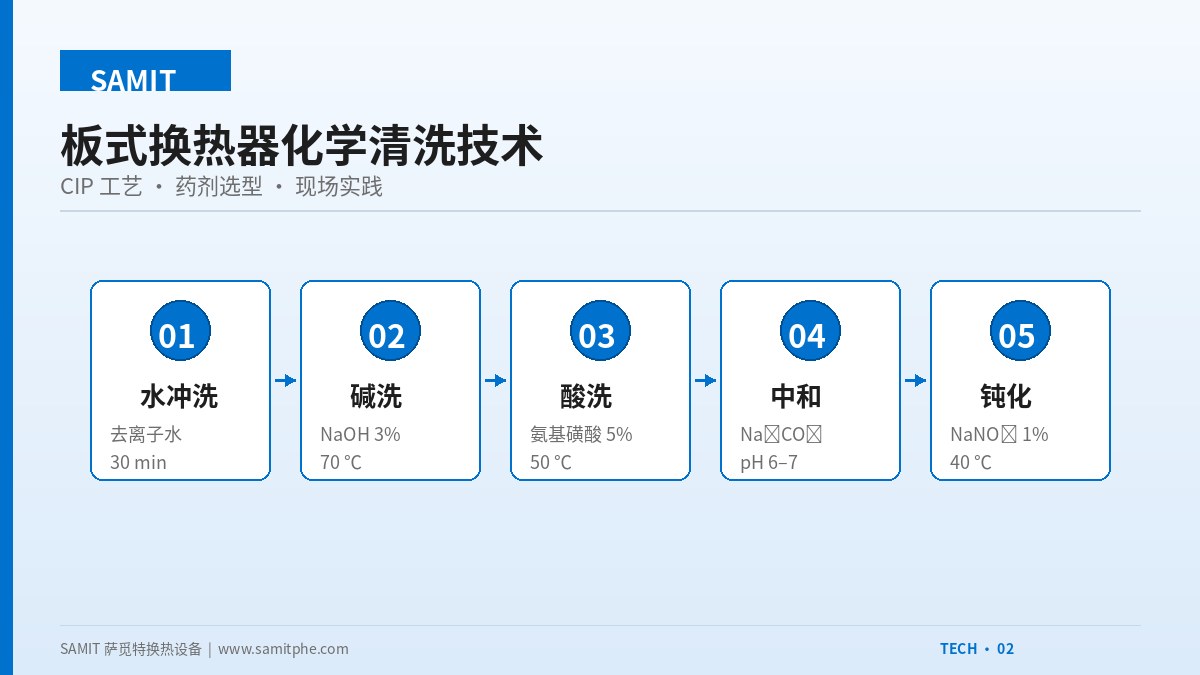
Standard 7-Step Process
- Water flush
- Alkaline wash — 85°C, <0.3 m/s, 10-24h, removes organics
- Post-alkali rinse to pH≤9
- Acid wash — the core descaling step
- Post-acid rinse
- Rinse — citric/phosphoric acid chelates residual Fe ions
- Neutralisation & passivation — forms protective film
| Scale Type | Main Agent | Temp |
|---|---|---|
| Carbonate (most common) | HCl 5-8% or sulphamic acid | ambient-40°C |
| Sulphate | EDTA / organic acids | 80-90°C |
| Iron oxide | HCl + trace HF | 40-50°C |
| Silicate | Caustic boil + HF | 90°C / 40°C |
Case Study: Alumina PHE at an Aluminium Plant
Stainless-steel detachable PHE with two-layer scale: surface carbonate (easy) and bottom alumina (hard). Only hot concentrated nitric acid dissolved the bottom layer. The "circulate + soak" route ran 12h at controlled velocity; corrosion rate 0.97 g/(m²·h) — well under the 6 g/(m²·h) safety limit; 100% descaling. Waste was neutralised with lime to meet GB 8978-1996.
Welded PHEs: Online Circulation Only
- Keep velocity under 0.5-0.6 m/s to preserve inhibitor effectiveness
- Add stabilisers to suspend particulate scale
- Best for soluble scales; limited on process-side organics
The SAMIT Service Standard
- No job without a bench-scale dissolution test
- Material-agent compatibility check for plates AND gaskets
- Real-time corrosion coupon monitoring; halt on threshold breach
If your PHE shows rising ΔP or shrinking ΔT, contact SAMIT for a free scale-sample evaluation.