Why Plate Heat Exchangers Corrode
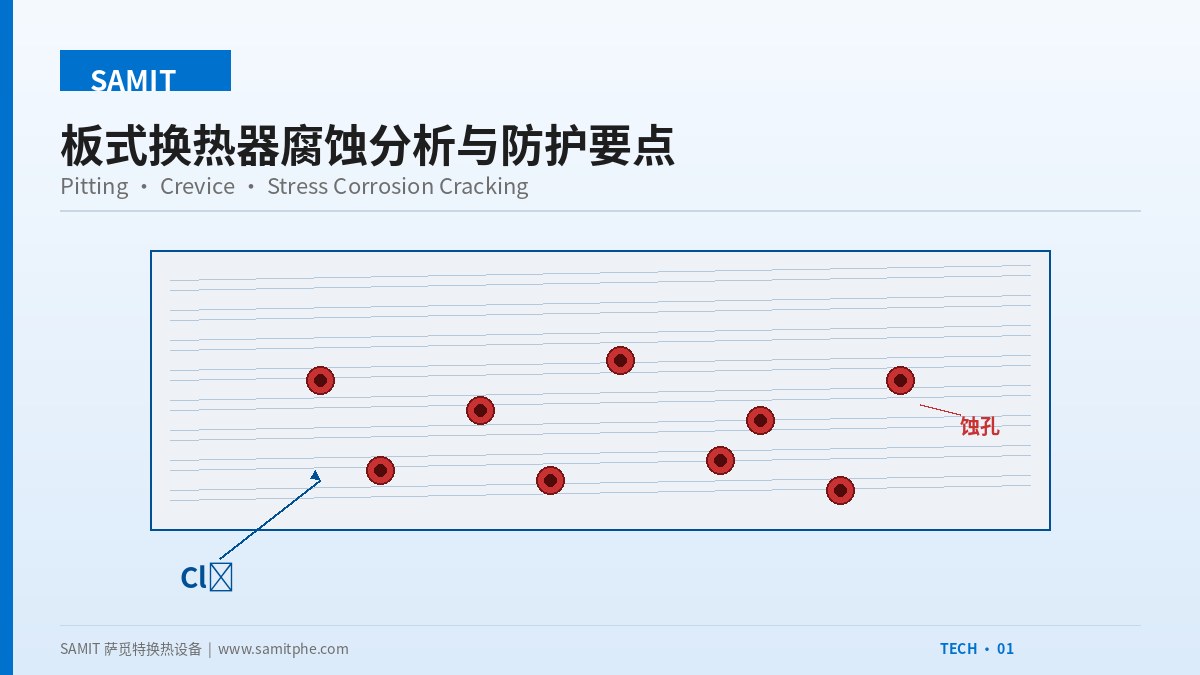
Detachable plate heat exchangers (PHEs) are valued for their high heat-transfer coefficient, compact footprint and cleanability across chemical, metallurgical, power, marine and HVAC industries. Limited by gasket temperature and pressure ratings, they typically operate below 2.5 MPa and 250 °C. In aggressive or fluctuating media, plate corrosion is almost inevitable — minor pitting degrades performance, severe pitting causes cross-contamination, internal leaks, and sometimes total equipment loss.
A PHE at a steel mill developed through-wall corrosion pits within its first year of service. Scanning electron microscopy with energy-dispersive spectroscopy (EDS) revealed iron sulphides as the dominant corrosion product, with elevated residual chlorides and sulphates — a textbook signature of stress-corrosion cracking.
Stress-Corrosion Mechanism
Stress corrosion requires two simultaneous conditions:
- Tensile stress — from press-forming residuals, clamp-up loads or pipe-induced stress. Stainless steels, titanium alloys and high-strength steels are all susceptible.
- Corrosive media — even trace Cl⁻ in water or humid air can initiate cracking; F⁻, Cl⁻, SO₄²⁻ with pH<7 aggressively attack the passive film.
Temperature amplifies the reaction rate — hot-side plates almost always fail first.
EDS Findings
| Position | Key Elements | Interpretation |
|---|---|---|
| 1 | Fe 47%, Cr 18%, Ni 15%, S 9% | Matrix dissolution + sulphide deposition |
| 2 | Fe 54%, Cr 21%, Ni 18%, Mo 6% | 316L matrix leaching |
| 3 | S 25%, Cu 44%, Fe 14% | Copper/iron sulphide enrichment |
High sulphur across all positions confirms an acidic sulphur-driven mechanism — a material upgrade alone cannot fix this without addressing the media environment.
Lifecycle Protection
Manufacturing: Stress Relief
Age stamped plates for ≥30 days or anneal them; protect surfaces from scratches that seed cracks.
Material Selection: Match the Media
- Cooling water, low Cl⁻: 304
- Chlorinated water, seawater: 316L minimum; titanium for high-Cl⁻
- Strong acids, reducing media: 254SMo or Hastelloy C-276
Operation: Media Monitoring
Track Cl⁻/SO₄²⁻/F⁻ and pH routinely; keep temperature and pH out of the aggressive window.
Maintenance: Annual Inspection
Open the bundle after 2 years of service; borescope hot-side, inlet and dead-flow zones.
The SAMIT Engineering View
At SAMIT, we treat a full media analysis as a non-negotiable upfront input — not to upsell material, but because stress corrosion costs you a production line, not a plate pack. If your PHE is leaking or losing performance, contact us for a media-material matching review.