Although plate heat exchangers are structurally simple, they can develop various faults in operation. Common faults fall into four categories: cross-contamination (internal leakage), pressure-drop rise, external leakage, and performance degradation. Mastering the characteristics, causes, and remedies of each fault type is essential for field engineers.
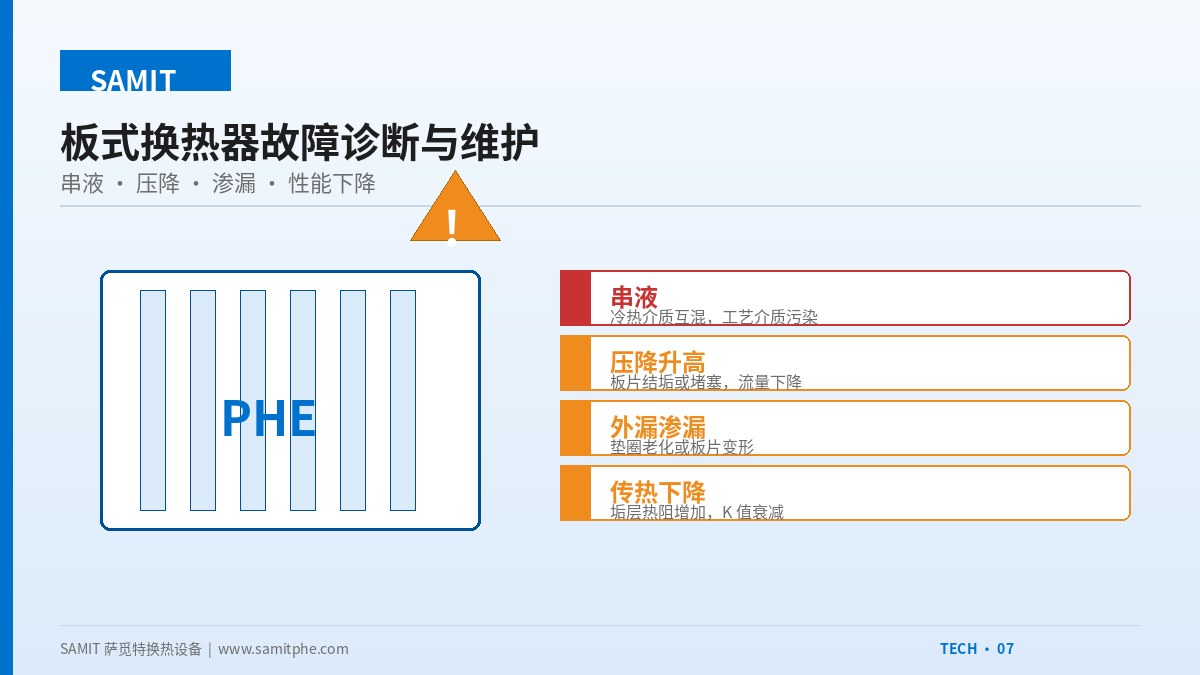
I. Four Major Fault Types
① Cross-Contamination (Internal Leakage)
Symptom: Hot and cold media mix, causing process-media contamination and abnormal temperatures.
Cause: Plate perforation (corrosion), gasket failure, uneven clamping force.
Severity:★★★★★ Critical—mixing of process media can cause product loss and safety incidents.
② Pressure-Drop Rise
Symptom: Inlet/outlet differential pressure at rated flow exceeds the design value by more than 30%.
Cause: Plate scaling and blockage, biological slime, solid-particle deposition.
Severity:★★★☆☆ Moderate—circulating-pump overload, insufficient flow.
③ External Leakage
Symptom: Liquid seeping from the PHE exterior, usually between plates or at corner ports.
Cause: Gasket aging, loose clamping bolts, plate deformation.
Severity:★★★★☆ High—media leakage can pollute the environment and injure personnel.
④ Performance Degradation
Symptom: Heat-transfer coefficient K decreases; design temperatures cannot be reached.
Cause: Plate scaling, flow deviation from design, changes in medium properties.
Severity:★★★☆☆ Moderate—process temperatures off-spec, rising energy use.
II. Five-Step Fault Diagnosis Procedure
III. Periodic Maintenance Schedule
| Interval | Inspection Item | Standard / Action |
|---|---|---|
| Every shift (8 h) | Inlet/outlet pressure, temperature, flow | Log data; deviations within ±10% are normal |
| Weekly | External leakage, fastener tightness | Shut down and inspect immediately if leakage is found |
| Monthly | Water-quality sampling (Cl⁻, pH, conductivity) | Cl⁻ ≤ 100 mg/L, pH 7.5–9.0 |
| Quarterly | Calculate actual K value | Deviation from design ≤ 15%; otherwise chemical cleaning |
| Semiannually | Open unit and inspect plates | Sample 5% of plates; focus on corner-port area |
| Annually | Verify clamping dimension | Within ±0.5% of nameplate; re-clamp if necessary |
| Every 3 years | Gasket replacement (high-temperature / corrosive duty) | EPDM 3 years, Viton 5 years, NBR 4 years |
| Every 5 years | Full overhaul with unit open | Plate cleaning + gasket replacement + plate flattening |
IV. Typical Fault Case: Cross-Contamination Incident Analysis
A PHE recovering waste heat in a methanol plant at a chemical works developed cross-contamination between hot and cold media after 14 months of operation, causing wide fluctuations in product quality. Incident analysis:
- Symptom: Cold-side outlet temperature abnormally rose by 12 °C; hot-side outlet temperature abnormally fell by 8 °C
- Diagnosis: Sampled the cold-side medium and detected characteristic components from the hot side, confirming cross-contamination
- Disassembly: Dense pitting perforations found near corner ports; maximum hole diameter 0.8 mm, fully penetrating
- Root cause: Circulating-water Cl⁻ chronically exceeded the limit (280 mg/L); 304 plates insufficiently corrosion-resistant at 78 °C
Remedial and improvement measures: ① Emergency replacement of plates with 316L; ② Installation of online Cl⁻ monitoring, controlled to ≤ 80 mg/L; ③ Reduction of inlet water temperature to 65 °C; ④ Addition of a "open and inspect every 6 months" maintenance item. No similar incident occurred within 3 years after the improvements.
V. Summary
90% of PHE faults originate from three factors: water quality, temperature, and maintenance. Establishing a complete maintenance system—from "shift inspection → monthly water quality → quarterly performance → semiannual sampling → annual clamping"—can extend the service life of PHEs from an average of 5 years to more than 10 years.