
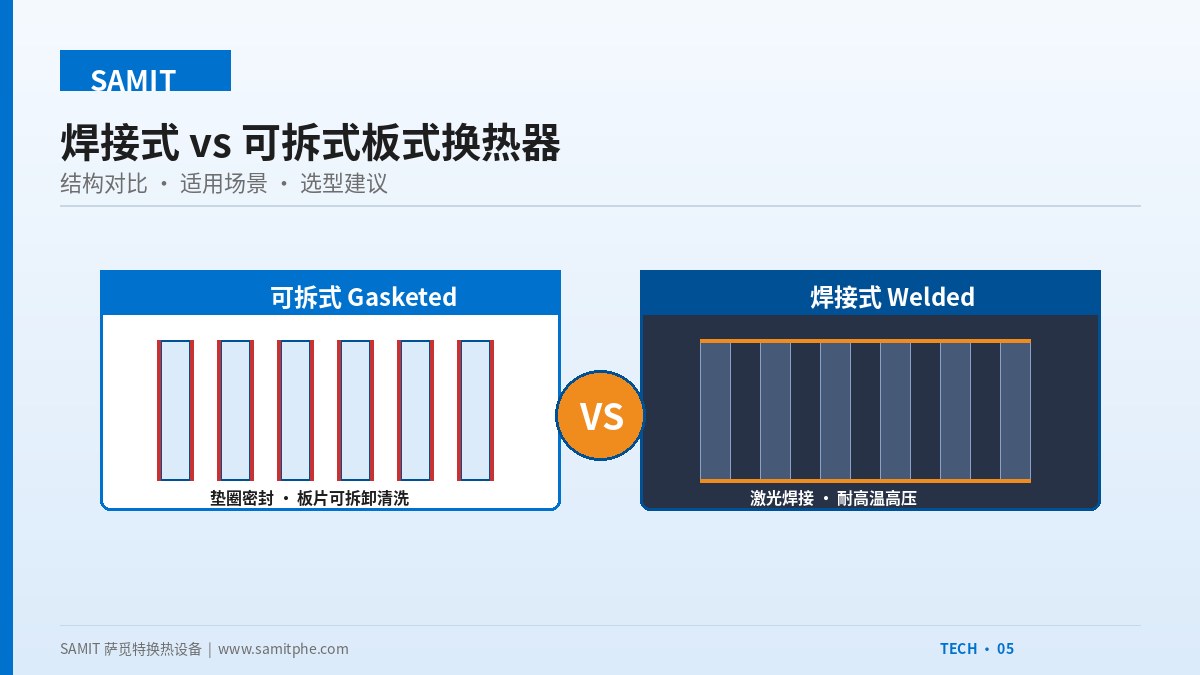
Welded and gasketed plate heat exchangers look similar; both are stacked-plate heat exchangers. However, their sealing principles, temperature/pressure resistance, and cleaning/maintenance methods are completely different. Wrong selection can lead to process failure or runaway maintenance costs. This article provides a systematic comparison.
I. Differences in Structural Principle
The biggest difference between the two types of heat exchangers is how the plates are sealed to one another:
II. Eight-Dimension Performance Comparison
| Comparison Dimension | Gasketed | Welded (Fully Welded) | Welded (Semi-Welded / Brazed) |
|---|---|---|---|
| Max working temperature | ≤ 180 ℃ (EPDM gaskets) | ≤ 350 ℃ | ≤ 225 ℃ (copper-brazed) / 300 ℃ (nickel-brazed) |
| Max working pressure | ≤ 2.5 MPa | ≤ 4.0 MPa | ≤ 3.0 MPa |
| Sealing method | Rubber / non-metallic gaskets | Same-metal welding | Copper / nickel brazing |
| Disassembly cleaning | ✔ Mechanical cleaning possible | ✘ Chemical cleaning only | ✘ Chemical cleaning only |
| Thermal fatigue resistance | Average (gasket aging) | Excellent (no gaskets) | Good |
| Initial investment | Low | High (about 1.8–2.5 times) | Medium (1.2–1.5 times) |
| Maintenance cost | High (periodic gasket replacement) | Low (no gaskets) | Low |
| Typical industries | HVAC, food, general chemical | Refining, high-temperature thermal oil | Refrigeration, closed-circuit systems |
III. Typical Application Scenarios
Choose Gasketed When
- Temperature ≤ 180 ℃, pressure ≤ 2.5 MPa
- Medium is prone to scaling and requires periodic mechanical cleaning
- Food, pharmaceutical, and other sanitary applications
- HVAC, building services, domestic hot water
- Multi-product small-batch production with frequently changing conditions
- Budget-sensitive projects
Choose Welded When
- Temperature > 200 ℃ or pressure > 2.5 MPa
- Medium is corrosive to rubber (strong solvents, aromatics)
- High-temperature thermal oil, biphenyl, molten salt
- Refinery hydroprocessing, ethylene plants, and other high-temperature processes
- 10+ years maintenance-free operation required
- Medium is clean and chemical cleaning is sufficient
IV. Selection Recommendations
Decision path: ① Operating temperature > 200 ℃? → Welded. ② Operating pressure > 2.5 MPa? → Welded. ③ Medium contains strong solvents or aromatics? → Welded. ④ Medium is prone to scaling and requires physical cleaning? → Gasketed. ⑤ Food / pharmaceutical / sanitary grade? → Gasketed. ⑥ None of the above? → Prefer gasketed (lower cost, more flexible maintenance).
V. Summary
Welded and gasketed types are not substitutes for each other but are complementary. Gasketed wins on flexibility and low cost, covering 70%+ of routine applications; welded wins on reliability in extreme conditions and is the only choice for high-temperature, high-pressure, and highly corrosive scenarios. The key to selection is not "which is better" but "which is better suited to your operating conditions."